

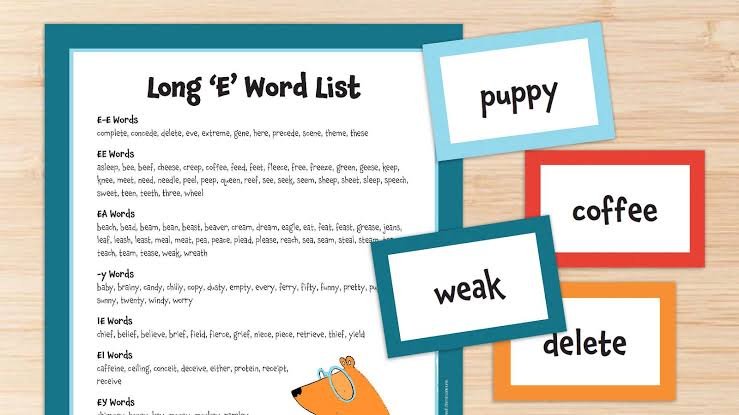
Long e words are an essential part of phonics because they help students understand how one vowel sound can appear through several different spelling patterns. The long e sound is pronounced /ē/, just like the name of the letter E. Familiar examples include bee, tree, green, feet, eat, beach, me, happy, and key. Recognizing this sound gives young readers a stronger foundation for decoding unfamiliar English words.
Learning long e words becomes easier when students focus on patterns rather than memorizing hundreds of individual spellings. The /ē/ sound can appear through ee, ea, a single e, final y, ie, ey, ei, and occasionally an e-e pattern. Some patterns are common, while others appear in fewer words. Understanding these differences can improve pronunciation, reading fluency, vocabulary development, and spelling accuracy for learners at different grade levels.
What Are Long E Words?
Long e words are words containing the /ē/ vowel sound heard in see, feet, beach, me, and happy. Unlike the short e sound in bed, red, pen, and ten, the long e sound resembles the spoken name of the letter E. It can occur at the beginning, middle, or end of a word, depending on its spelling pattern and syllable structure.
English uses several ways to represent the same long e sound, which can initially make spelling challenging. For example, green uses ee, clean uses ea, me uses a single e, happy ends in y, piece uses ie, and key uses ey. Once students begin identifying these visual patterns, they can connect new vocabulary to spellings they already recognize and become more confident readers.
Common Long E Words
Many common long e words are short, familiar, and easy for beginning readers to pronounce. Examples include be, he, me, she, we, bee, see, tree, three, feet, meet, need, feed, seed, keep, deep, sleep, sheep, week, green, sweet, and queen. These words are useful because students encounter them frequently in classroom texts, picture books, conversations, and early reading activities.
Additional examples include eat, sea, tea, leaf, beach, peach, clean, dream, team, seat, read, speak, teach, happy, baby, funny, sunny, city, family, key, chief, field, piece, belief, and relief. Practicing words from several spelling groups helps learners understand that pronunciation is based on sound patterns rather than one fixed combination of letters.
Long E Words With EE
The ee spelling pattern is one of the most recognizable ways to represent the long e sound. Common examples include bee, see, tree, three, feet, meet, need, feed, seed, deep, keep, sleep, sheep, week, green, screen, creek, sweet, sweep, street, freeze, breeze, queen, speech, cheek, bleed, greet, sheet, fleet, steel, indeed, and between.
Students often find ee words easier because the spelling pattern produces the /ē/ sound consistently in many familiar examples. Teachers can introduce words such as see, tree, feet, and green before moving toward longer vocabulary like screen, speech, between, and seventeen. Reading these words aloud, sorting them, and using them in short sentences can strengthen both visual recognition and accurate pronunciation.
Long E Words With EA
The ea spelling pattern also creates the long e sound in many everyday English words. Examples include eat, each, sea, tea, beach, leaf, peach, clean, dream, team, seat, read, speak, teach, beam, bean, beak, cream, deal, heat, lean, meat, reach, steam, treat, weak, wheat, please, season, teacher, reading, and meaning.
Although ea frequently represents /ē/, students should learn that the pattern has exceptions. Words such as bread, head, heavy, and weather use different vowel sounds even though they contain ea. Instead of teaching ea as an absolute rule, teachers can describe it as a common pattern. This approach helps children become flexible readers who recognize regular spellings while gradually learning exceptions through repeated exposure.
Long E Words With Single E and Final Y
A single e sometimes creates the long e sound, especially in open syllables. Simple examples include be, he, me, she, and we. Longer examples may include even, equal, legal, recent, secret, zero, hero, complete, delete, concrete, extreme, convenient, and frequent. Understanding open syllables can help students predict when a single vowel is more likely to pronounce its letter name.
Final y is another important pattern in long e words, particularly in multisyllable vocabulary. Examples include happy, baby, funny, sunny, candy, city, puppy, pretty, silly, family, story, twenty, sleepy, rainy, tiny, lucky, messy, friendly, slowly, safely, healthy, easy, lovely, and quietly. Teaching these words as a group helps students recognize that y can function as a vowel when it appears at the end.
Long E Words With IE, EY, EI, and E-E
Less common long e spelling patterns are still important because they appear in many useful words. The ie pattern appears in chief, brief, field, piece, thief, belief, relief, grief, shield, yield, niece, priest, and retrieve. The ey pattern appears in key, monkey, honey, turkey, valley, chimney, and journey. These spellings become easier when students practice them alongside more familiar ee and ea examples.
The ei pattern can produce the long e sound in words such as receive, deceive, ceiling, seize, and protein, while the e-e pattern appears in words such as theme, complete, concrete, and extreme. Because these patterns occur less frequently, they are usually introduced after students understand the more common forms. Grouping examples by spelling allows learners to notice similarities while also building a broader vocabulary.
Easy Long E Words for Kids
Young learners should begin with long e words that are easy to recognize, pronounce, and connect with familiar objects or ideas. Good examples include be, he, me, she, we, bee, see, tree, feet, eat, tea, sea, key, green, sleep, sheep, leaf, peach, seat, team, happy, baby, funny, sunny, candy, clean, dream, and speak.
Parents and teachers can use pictures, flashcards, short stories, or matching games to make these words memorable. A picture of a bee can be paired with bee, while a tree image can reinforce tree. Students can also identify the long e sound before studying the spelling. Connecting sound, image, pronunciation, and written form creates several learning pathways and can make phonics practice more engaging.
Long E Words for Different Grade Levels
Kindergarten and first-grade students usually begin with simple examples such as bee, see, tree, me, he, we, feet, seed, green, eat, sea, tea, sleep, sheep, leaf, peach, and happy. These words provide clear examples of the long e sound and allow teachers to introduce a few spelling patterns without overwhelming students with too many irregular forms at once.
Second- and third-grade students can work with more complex vocabulary such as freeze, breeze, screen, speech, complete, belief, relief, receive, ceiling, season, reading, teacher, family, meaning, peaceful, achievement, agreement, leadership, meaningful, creativity, frequency, convenient, repeatedly, immediately, and independently. Grade-level progression should focus on increasing complexity while continuing to reinforce patterns that students already recognize from earlier reading lessons.
Long E Spelling Patterns and Rules
Understanding spelling patterns gives students a practical way to decode unfamiliar long e words. The ee pattern appears in green and sleep, ea appears in beach and clean, a single e appears in me and even, final y appears in happy, ie appears in piece, ey appears in key, and ei appears in receive. Each pattern provides a visual clue to the same /ē/ pronunciation.
English spelling contains exceptions, so these patterns should be taught as strong tendencies rather than unbreakable rules. For example, ea does not make /ē/ in bread or head, and ie can produce other sounds in different words. Students benefit when teachers combine phonics rules with repeated reading exposure. This balanced approach helps learners use patterns confidently while remaining prepared for irregular spellings.
Long E vs Short E Words
Understanding the difference between long and short vowel sounds is important for accurate reading. Long e sounds like /ē/ in feet, meet, green, and beach, while short e sounds like /ĕ/ in bed, met, red, and pen. Comparing similar words can make the contrast clearer, especially for students who rely heavily on visual spelling rather than listening carefully to pronunciation.
Useful comparison pairs include meet and met, bead and bed, feel and fell, teen and ten, and heel and held. Teachers can say each pair slowly and ask students to identify which word contains the long sound. Students can then underline the vowel pattern responsible for the pronunciation. This listening-and-reading exercise strengthens phonemic awareness while connecting spoken sounds with written English.
How to Teach Long E Words
Teaching long e words effectively usually begins with the most predictable spellings, particularly ee and ea. Students can read a short collection aloud, identify the repeated vowel pattern, and sort examples into groups. Teachers can then introduce final y, single e, ie, ey, and ei gradually. Presenting patterns in stages prevents students from becoming overwhelmed while still showing the variety of English spelling.
Effective instruction should combine reading, speaking, listening, and writing. Students might read green, say the word aloud, identify ee, write the word, and then use it in a sentence. Repeating this process with several examples helps build automatic recognition. Teachers can also revisit previously learned patterns during new lessons so students strengthen long-term memory rather than treating each phonics topic as an isolated unit.
Long E Word Games and Activities
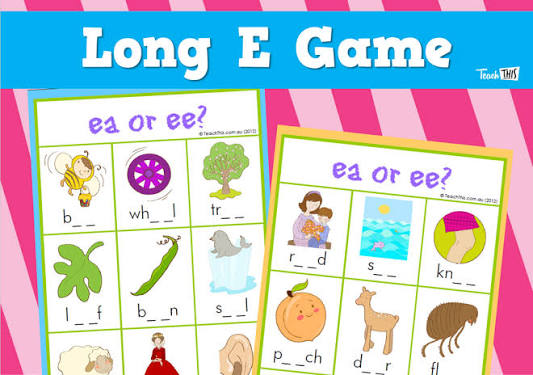
Games can transform long e words practice from repetitive memorization into active learning. Useful activities include word bingo, matching cards, sound hunts, memory games, spelling races, picture matching, word searches, fill-in-the-blank sentences, and sorting challenges. Students can also search classroom books for words containing the /ē/ sound and record their discoveries in separate spelling-pattern categories.
Another effective activity is creating a long e word wall. Students can add new examples beneath headings such as ee, ea, y, ie, and ey throughout the week. Teachers can later use those words for quick reading drills or sentence-building exercises. By repeatedly seeing words in meaningful classroom contexts, students develop faster recognition and become more confident using vowel patterns independently.
Long E Words in Sentences
Reading vocabulary inside sentences helps students move beyond isolated pronunciation and understand how words function in context. Simple examples include “The green tree is tall,” “We see three sheep,” “She will eat a peach,” “Please keep your feet clean,” and “The happy baby went to sleep.” These sentences contain several long e examples while remaining easy enough for early readers to understand.
Older students can practice longer sentences such as “The teacher asked the team to read quietly,” or “She received a key before leaving the peaceful valley.” Sentence practice strengthens decoding, fluency, comprehension, and spelling at the same time. Students can also create their own sentences using assigned vocabulary, which encourages active recall and demonstrates whether they understand both pronunciation and meaning.
200+ Long E Words List
A broad long e words list may include bee, see, tree, three, feet, meet, need, feed, seed, deep, keep, sleep, sheep, week, green, screen, creek, sweet, sweep, street, freeze, breeze, queen, speech, cheek, bleed, greet, sheet, fleet, steel, between, eat, each, sea, tea, beach, leaf, peach, clean, cream, dream, team, seat, read, speak, and teach.
Additional examples include beam, bean, beak, reach, steam, meat, wheat, please, season, teacher, reading, meaning, be, he, me, she, we, even, equal, legal, recent, secret, zero, hero, happy, baby, funny, sunny, candy, city, family, pretty, key, monkey, honey, chief, brief, field, piece, thief, belief, relief, receive, deceive, ceiling, seize, complete, concrete, extreme, peaceful, leadership, meaningful, agreement, achievement, and creativity.
Long E Worksheets and Printable Practice
Printable practice can reinforce long e words by giving students structured opportunities to recognize, spell, and use different patterns. Helpful worksheets include ee versus ea sorting, missing-letter exercises, picture matching, word searches, sentence completion, reading passages, dictation lists, and word-family activities. Teachers can select easier worksheets for beginners and introduce more complex spelling combinations as learners gain confidence.
A printable master list can also serve as a classroom reference, homework sheet, or spelling resource. Organizing vocabulary by pattern or grade level makes the list more useful than presenting hundreds of unrelated examples. Students can highlight familiar words, circle new words, or mark difficult spellings. These simple interactions encourage active learning while giving teachers an easy way to monitor progress over time.
Why Long E Words Matter in Phonics
Long e words are important because they demonstrate one of the central principles of English phonics: a single speech sound can be represented by several spelling patterns. Students who recognize these patterns can decode unfamiliar vocabulary more efficiently, rather than guessing words letter by letter. This skill becomes increasingly valuable as reading materials introduce longer, more complex, and multisyllable vocabulary.
Strong vowel knowledge also supports spelling, pronunciation, fluency, vocabulary growth, and reading comprehension. When students automatically recognize patterns such as ee, ea, final y, and ie, they can focus more attention on understanding the meaning of a sentence. Consistent phonics practice therefore does more than improve isolated word reading; it helps build the automatic decoding skills necessary for confident, fluent reading.
Conclusion
Long e words contain the /ē/ vowel sound and can be spelled through several patterns, including ee, ea, single e, final y, ie, ey, ei, and e-e. Common examples such as bee, green, beach, me, happy, key, and piece demonstrate how varied English spelling can be while still producing the same recognizable vowel sound.
Students can master these patterns through repeated reading, word sorting, games, worksheets, sentence practice, and spelling activities. Rather than memorizing every word separately, learners should focus on recognizing recurring visual and sound relationships. With consistent practice, long e words become easier to decode, pronounce, spell, and use confidently in everyday reading and writing.
FAQs
What are long e words?
Long e words contain the /ē/ vowel sound heard in examples such as bee, tree, green, eat, beach, me, happy, and key.
What are 10 examples of long e words?
Bee, see, tree, green, sleep, feet, eat, beach, happy, and key are ten common examples of the long e sound.
What are long e words with EE?
Examples include bee, tree, feet, green, sleep, seed, week, queen, sweep, creek, freeze, and breeze.
What are long e words with EA?
Examples include eat, beach, leaf, clean, dream, seat, peach, team, teach, read, speak, and cream.
What spelling patterns make the long e sound?
Common patterns include ee, ea, single e, final y, ie, ey, ei, and e-e, although English contains exceptions.
What is the difference between long e and short e?
Long e sounds like /ē/ in feet and green, while short e sounds like /ĕ/ in bed, red, and pen.
How can children practice long e words?
Children can practice with word lists, phonics games, reading exercises, sorting activities, worksheets, picture matching, spelling drills, and sentence writing.
You May Also Read: What Is Rigor Mortis