

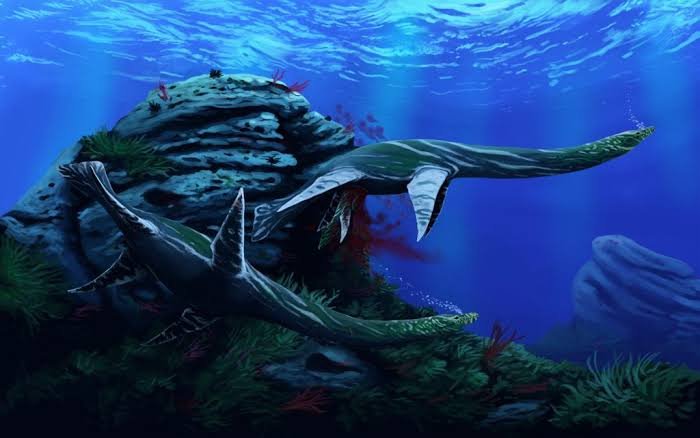
Plesiosaurus was one of the most recognizable marine reptiles of the Early Jurassic, famous for its unusually long neck, small head, broad body, and four paddle-like limbs. Although it lived during the age of dinosaurs, it was not a dinosaur. Instead, it belonged to a separate lineage of marine reptiles adapted entirely for life in ancient seas, where it hunted smaller aquatic animals and moved through the water using its powerful flippers.
The fossil record has made Plesiosaurus especially important to paleontology because relatively complete skeletons have helped researchers study its body proportions and aquatic adaptations. Fossils discovered in England also connect this animal with some of the earliest major breakthroughs in prehistoric reptile research. Its unusual appearance, scientific history, and mysterious lifestyle continue to make it a fascinating subject for anyone interested in Jurassic wildlife and prehistoric oceans.
What Was Plesiosaurus?
Plesiosaurus was a genus of extinct marine reptiles belonging to a broader group known as plesiosaurs. The genus is especially associated with the Early Jurassic and is known from important fossil material discovered in England. These reptiles were sauropterygians, an evolutionary group separate from dinosaurs. Their bodies were highly specialized for swimming, with four large limbs transformed into paddles and a torso designed for an entirely aquatic lifestyle.
It is also important to distinguish Plesiosaurus from the word plesiosaur. Plesiosaur is the broader term used for members of Plesiosauria, a diverse marine reptile group that survived for a large portion of the Mesozoic Era. Plesiosaurus, however, refers to a particular genus within that group. Plesiosaurs lived in the oceans while dinosaurs occupied many terrestrial environments, meaning the two groups coexisted without being the same type of animal.
Was Plesiosaurus a Dinosaur?
Plesiosaurus was not a dinosaur, even though popular books, movies, games, and toys sometimes place it in the same general category. True dinosaurs belonged to Dinosauria and developed a distinct skeletal structure and evolutionary history. Plesiosaurs came from a different branch of reptiles and evolved specifically for marine life. Their paddle-shaped limbs, broad bodies, and aquatic locomotion separated them clearly from the dinosaurs living on land.
This distinction is similar to the difference between flying pterosaurs and dinosaurs. Several prehistoric reptile groups lived during the Mesozoic, but sharing the same geological era does not make them dinosaurs. Museums and scientific sources therefore describe plesiosaurs as extinct marine reptiles. Understanding this classification helps readers build a more accurate picture of prehistoric ecosystems, where dinosaurs, marine reptiles, flying reptiles, fish, and many other animals occupied very different environments.
Plesiosaurus Size and Appearance
Plesiosaurus is commonly estimated at around 3.5 meters, or approximately 11 feet, in length. Its proportions made it instantly recognizable: a long and relatively slender neck supported a small head, while a broad body connected to a short tail. Four elongated paddle-like limbs extended from the body, giving the reptile a silhouette unlike most modern marine animals. These features were important adaptations for navigating Jurassic seas.
Not every plesiosaur had the same proportions or size. Some later members of the wider group became considerably larger or developed even more extreme neck lengths. This is why size estimates for giant plesiosaurs should not automatically be applied to this particular genus. Its roughly 11-foot length made it impressive, but it was not among the largest marine reptiles ever known. Its distinctive anatomy, rather than enormous size, is what made it scientifically remarkable.
Why Did Plesiosaurus Have a Long Neck?
The long neck has inspired debate because researchers cannot directly observe how the animal used it. One possibility is that the neck allowed the head to approach fish and other prey while the larger body remained farther away. A relatively small head moving near prey might have created less disturbance than the entire torso rushing forward, potentially helping the animal capture small, agile creatures in the water.
Older illustrations sometimes portrayed the neck as extremely flexible, bending and twisting like a snake. Modern anatomical interpretations are generally more cautious because the shape and articulation of the vertebrae suggest limits on dramatic movement. The neck was certainly elongated, but it probably could not form the exaggerated curves shown in some artwork. Researchers therefore study vertebral anatomy and biomechanics to estimate realistic ranges of motion instead of relying on visual imagination.
How Did Plesiosaurus Swim?
Plesiosaurus moved through the water with four large paddles rather than depending mainly on powerful tail strokes like many fish. Paleontologists often compare plesiosaur locomotion to underwater flight because the limbs may have generated lift and thrust through coordinated strokes. Both front and rear flippers likely contributed to propulsion, although researchers continue investigating exactly how the two pairs interacted during steady swimming, acceleration, turning, and pursuit of prey.
This four-flipper body plan was unusual and became one of the defining characteristics of plesiosaurs. The front limbs may have supplied much of the forward thrust, while the rear pair could have contributed additional power or maneuverability. The broad torso probably remained comparatively stable as the paddles moved around it. Such a swimming system would have made these reptiles very different from streamlined ichthyosaurs, which had body shapes more reminiscent of modern fast-swimming marine animals.
What Did Plesiosaurus Eat?
Plesiosaurus was a carnivore that probably consumed fish, cephalopods, and other relatively small marine animals. Its narrow jaws and pointed teeth appear suitable for gripping slippery prey rather than crushing large bones or armored shells. Ancient Jurassic seas contained abundant fish and invertebrates, giving a medium-sized marine predator access to many potential food sources. Its feeding ecology was therefore closely connected with the diverse ocean ecosystems of the Early Jurassic.
Scientists reconstruct diet by studying skull structure, tooth shape, associated fossils, and evidence from closely related plesiosaurs. In some marine reptiles, preserved stomach contents provide additional clues about feeding behavior. However, not every dietary detail can be proven directly for this genus. Statements about exact hunting techniques should therefore be presented carefully. The strongest evidence suggests a predator adapted to catching aquatic prey rather than attacking extremely large animals.
Where Did Plesiosaurus Live?
Plesiosaurus lived in marine environments during the Early Jurassic, when the arrangement of continents and oceans looked very different from today. Important fossils are especially associated with Jurassic rocks in England. These deposits formed in ancient marine settings, demonstrating that areas now exposed as cliffs and land were once connected with seas inhabited by reptiles, fish, ammonites, and numerous other marine organisms.
The ancient seas offered abundant food and a wide variety of ecological niches. Plesiosaurs shared these environments with ichthyosaurs, fish, cephalopods, and many invertebrate species. Dinosaurs existed at the same time but primarily inhabited terrestrial ecosystems. Thinking about Jurassic life as separate ocean and land communities gives a more realistic view than imagining every prehistoric animal living together. Marine reptiles developed their own specialized adaptations for surviving far from terrestrial environments.
Plesiosaurus Fossils and Mary Anning
The scientific history of Plesiosaurus is closely associated with Mary Anning, the renowned English fossil collector whose discoveries along the Jurassic Coast transformed early paleontology. Fossils uncovered from the rocks around Lyme Regis revealed animals unlike anything living today. A nearly complete plesiosaur skeleton was particularly striking because scientists had never encountered such an unusual combination of a small head, long neck, broad torso, and powerful swimming paddles.
Plesiosaurus dolichodeirus became especially important in the history of fossil research. Discoveries associated with Anning helped nineteenth-century scientists recognize that dramatically different animals had once inhabited Earth’s oceans and later become extinct. Her work contributed to changing scientific ideas about ancient life and geological time. Today, these fossils remain valuable not only for understanding plesiosaur anatomy but also for appreciating how early paleontology developed into a modern scientific discipline.
What Plesiosaurus Fossils Reveal
A fossil skeleton can reveal much more than an extinct animal’s general appearance. Researchers study vertebrae to understand neck structure, limb bones to reconstruct swimming mechanics, teeth to investigate diet, and overall proportions to estimate body size. Bone surfaces may even preserve evidence of growth, injuries, or disease. By comparing multiple specimens, paleontologists can also explore variation between individuals and identify features that distinguish one prehistoric reptile group from another.
The rocks surrounding fossils provide another layer of evidence. Sediment type, associated shells, fossil fish, and geological dating methods help reconstruct the environments in which these animals lived. Scientists can therefore investigate not only the reptile itself but also the wider ecosystem around it. This combination of anatomical and geological evidence is what allows modern paleontology to transform isolated fossil bones into detailed reconstructions of ancient marine environments.
Plesiosaurus vs Mosasaurus
Plesiosaurus and Mosasaurus were both prehistoric marine reptiles, but they belonged to very different evolutionary groups and had strikingly different bodies. The plesiosaur body plan included four large paddles, a broad torso, and, in long-necked forms, an elongated neck. Mosasaurs were more elongated reptiles with powerful tails and swimming adaptations that gave them an appearance closer to giant aquatic lizards than long-necked plesiosaurs.
Timing is another important difference. Plesiosaurus is primarily associated with the Early Jurassic, while mosasaurs became prominent much later during the Late Cretaceous. This means fictional battles between the classic Plesiosaurus genus and Mosasaurus can create misleading impressions about prehistoric history. Comparing them scientifically is more useful: each represents a different evolutionary experiment in adapting reptiles to marine life, separated by anatomy, ancestry, and significant geological time.
Plesiosaurus vs Elasmosaurus
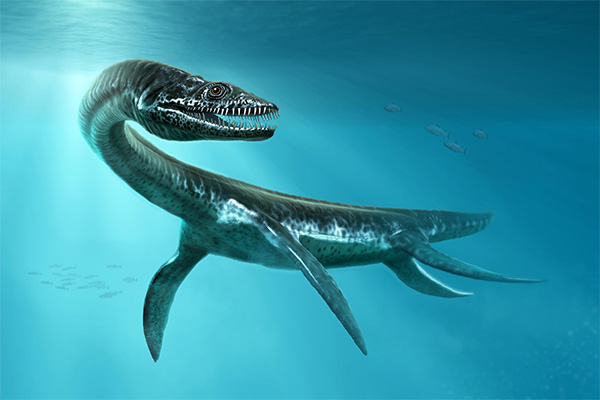
Elasmosaurus was another plesiosaur, but it lived considerably later and developed much more extreme body proportions. It is famous for having an extraordinarily long neck containing many vertebrae. Although people sometimes use images of Elasmosaurus when discussing Plesiosaurus, the two genera were distinct animals that lived during different periods and should not be treated as interchangeable examples of one species.
The comparison demonstrates how diverse the plesiosaur lineage became. Early forms established the successful basic body plan of four paddles and a marine lifestyle, while later groups developed different skull sizes, neck lengths, and feeding adaptations. Studying these variations helps paleontologists understand how plesiosaurs occupied multiple ecological roles over millions of years. It also prevents the common mistake of assuming that every long-necked plesiosaur looked exactly like the same classic reconstruction.
Plesiosaurus vs Ichthyosaurus
Ichthyosaurs were marine reptiles too, but their anatomy differed dramatically from that of long-necked plesiosaurs. Many ichthyosaurs developed streamlined, fish-like bodies with strong tails and shapes that are often compared with dolphins. These similarities to modern marine animals resulted from convergent evolution, where unrelated groups developed comparable adaptations because they faced similar challenges when moving efficiently through open water.
Plesiosaurs followed a different evolutionary path. Their four powerful paddles and broad bodies created a distinctive method of underwater locomotion. Comparing these groups shows that there was no single successful design for a Mesozoic marine reptile. Ancient oceans supported multiple reptile lineages, each using different anatomical solutions for swimming, hunting, and survival. That diversity made prehistoric marine ecosystems far more complex than simple collections of giant sea monsters.
How Did Plesiosaurus Become Extinct?
The extinction story requires an important distinction between the genus and the wider plesiosaur group. Plesiosaurus itself is associated with the Early Jurassic and disappeared long before the catastrophic end-Cretaceous extinction event. Therefore, saying that the asteroid impact 66 million years ago directly killed this particular genus would be inaccurate. Species and genera naturally appeared, changed, and disappeared throughout the long history of the Mesozoic.
Plesiosaurs as a broader group survived much longer, remaining successful marine reptiles into the Late Cretaceous. They finally disappeared during the mass extinction at the end of that period, alongside non-avian dinosaurs and many marine organisms. Environmental disruption following the impact profoundly affected food chains across land and sea. The extinction of the wider plesiosaur lineage therefore occurred millions of years after the classic Early Jurassic genus had already vanished.
Could Plesiosaurs Still Exist Today?
There is no credible scientific evidence that plesiosaurs survive in modern oceans or lakes. These reptiles are known through fossils, and their record ends in the Mesozoic. A surviving population of large air-breathing marine reptiles would be expected to leave multiple forms of evidence, including bodies, bones, environmental traces, repeated observations, or genetic material. None has been scientifically verified as evidence of a living plesiosaur population.
Stories about mysterious long-necked lake monsters are sometimes compared with plesiosaurs because the silhouette seems familiar. The Loch Ness Monster is perhaps the most famous example of this cultural connection. However, legends and unexplained observations are not equivalent to paleontological evidence. Science requires physical material that can be independently examined and tested. Without such evidence, modern plesiosaur survival remains an entertaining idea rather than a supported scientific conclusion.
Interesting Plesiosaurus Facts
Plesiosaurus was an Early Jurassic marine reptile, not a dinosaur, and its estimated length of roughly 11 feet makes it smaller than many people imagine. Its body featured four large paddles, a broad torso, a relatively short tail, a small skull, and a long neck. Its unusual skeleton fascinated early researchers because nothing living today has exactly the same combination of anatomical features.
Its fossils also played an important role in the history of paleontology, particularly through discoveries connected with Mary Anning. The broader plesiosaur lineage became enormously successful and survived for well over 100 million years before disappearing at the end of the Cretaceous. Their long evolutionary history demonstrates that the four-flipper swimming body plan was not a strange evolutionary failure but a highly successful adaptation to life in ancient oceans.
Conclusion
Plesiosaurus remains one of the most memorable prehistoric marine reptiles because its anatomy was unlike anything alive today. Its long neck, compact head, broad torso, short tail, and four swimming paddles created a distinctive profile perfectly suited to Jurassic seas. Fossils suggest that it was a carnivorous marine predator that probably hunted fish and other relatively small aquatic animals while using its four flippers for controlled underwater movement.
Its scientific importance reaches beyond appearance. Fossil discoveries linked with Mary Anning helped transform nineteenth-century understanding of extinction and prehistoric life, while modern research continues investigating plesiosaur swimming, feeding, and anatomy. Recognizing that these reptiles were not dinosaurs also improves our understanding of Mesozoic biodiversity. Ancient oceans contained their own remarkable evolutionary communities, and plesiosaurs remain among the clearest examples of that lost marine world.
FAQs
Was Plesiosaurus a dinosaur?
No. It was a marine reptile belonging to the plesiosaur lineage, which was evolutionarily separate from true dinosaurs.
How big was Plesiosaurus?
Common estimates place it at approximately 3.5 meters, or around 11 feet, in total length.
What did Plesiosaurus eat?
It was carnivorous and probably consumed fish, cephalopods, and other relatively small animals living in Jurassic seas.
Where did Plesiosaurus live?
It lived in Early Jurassic marine environments, with especially important fossil discoveries coming from England.
Who discovered Plesiosaurus?
Mary Anning is closely associated with a major early plesiosaur discovery that became highly important to nineteenth-century paleontology.
Why did Plesiosaurus have a long neck?
The neck may have helped position its small head near prey, although scientists continue studying exactly how it functioned during feeding.
How did Plesiosaurus swim?
It used four paddle-like limbs, probably generating thrust through coordinated movements sometimes compared with underwater flight.
Are plesiosaurs still alive today?
No credible scientific evidence shows that plesiosaurs survived beyond the end of the Mesozoic into modern times.
You May Also Read: Long E Words