

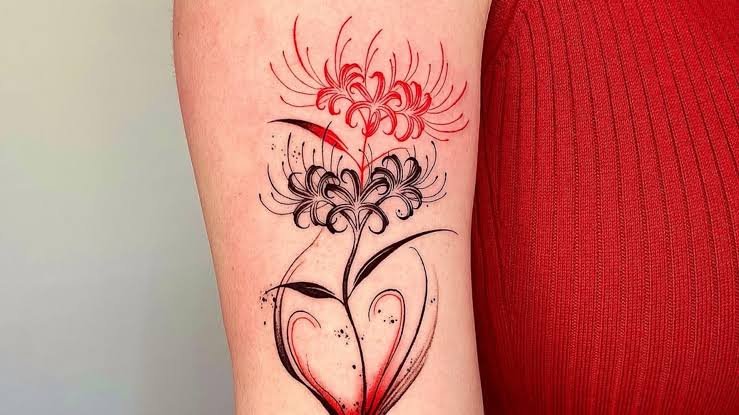
A red spider lily tattoo is more than a striking floral design. Its thin curling petals, vivid red color, and unusual shape create an instantly recognizable look, while its symbolism connects with farewell, remembrance, transformation, rebirth, passion, and emotional strength. Because the flower can express both sorrow and hope, it attracts people who want body art that represents an important personal story rather than decoration alone.
The red spider lily is also closely associated with Japanese cultural imagery, where it is commonly known as Higanbana. Its appearance in folklore, seasonal traditions, cemeteries, art, anime, and modern tattoo culture has given the flower multiple layers of meaning. Today, a red spider lily tattoo can be minimalist or elaborate, deeply personal or visually dramatic, depending on the wearer’s interpretation, tattoo style, and preferred placement.
Red Spider Lily Tattoo Meaning
The meaning of a red spider lily tattoo often centers on farewell, separation, memory, and major life transitions. Someone may choose the flower after losing an important person, ending a meaningful relationship, moving away from an old life, or accepting that a certain chapter has permanently closed. In that context, the tattoo can become a quiet reminder that endings remain meaningful even when they are painful.
However, the symbolism is not limited to sadness. A red spider lily tattoo can also represent personal rebirth, resilience, and the decision to continue moving forward. The flower may symbolize surviving emotional hardship and becoming stronger afterward. Because its meaning can shift between loss and renewal, it works particularly well for people who want a tattoo representing both what they have left behind and who they are becoming.
Farewell, Loss, and Remembrance Symbolism
Farewell is one of the strongest themes associated with the red spider lily. For many tattoo wearers, the design becomes a visual representation of saying goodbye without erasing the emotional connection to a person, place, or period of life. It may represent memories that remain important even after circumstances change, making the flower especially meaningful for memorial tattoos and deeply personal pieces centered on remembrance.
A red spider lily tattoo does not need to communicate grief in an obvious way. A single flower, falling petals, initials, a date, or another subtle element can quietly represent someone who is gone. Instead of focusing only on death, the design can express appreciation for shared memories and the influence that person continues to have. This makes the flower both emotionally powerful and visually graceful as a memorial symbol.
Rebirth and Transformation Meaning
Transformation gives the red spider lily a more hopeful interpretation. People often choose symbolic tattoos after major life changes, and this flower can represent the moment when someone decides to leave an older identity behind. A red spider lily tattoo may mark recovery from a difficult experience, the end of a harmful relationship, a new career, personal independence, or any change that reshapes how someone understands themselves.
The concept of rebirth does not necessarily mean forgetting the past. Instead, the flower can represent accepting what happened while choosing to continue growing. Its vivid bloom makes that message especially effective because the design can appear intense and alive despite its associations with endings. In this way, the tattoo becomes a symbol of emotional evolution, reminding the wearer that meaningful change often begins after something familiar has ended.
Japanese Red Spider Lily Tattoo Meaning
In Japan, the red spider lily is commonly called Higanbana. The flower is strongly associated with seasonal transition, particularly around the autumn equinox, and it often appears near cemeteries and pathways. Over time, these associations contributed to cultural connections with separation, remembrance, death, and the boundary between one stage of existence and another. These meanings have influenced art, literature, anime, and modern tattoo imagery.
A Japanese-inspired red spider lily tattoo should be approached with an understanding that cultural symbolism is complex rather than reduced to a simple “death flower” meaning. Higanbana can represent farewell, memory, transition, and reunion in different contexts. Someone choosing this imagery may connect with its emotional depth while also appreciating its visual beauty. Respectful research can help ensure the tattoo feels meaningful rather than using cultural symbolism only as decoration.
Passion, Strength, and Emotional Power
The flower’s intense red color introduces another layer of symbolism. Red is commonly associated with passion, courage, determination, energy, love, and emotional intensity. When incorporated into a red spider lily tattoo, these associations can shift the design away from purely melancholic themes. The flower can represent someone who feels deeply, survives difficult moments, and continues moving forward with a strong sense of identity.
This interpretation works particularly well for people who see their tattoo as a statement of personal strength. The combination of delicate petals and bold color creates an interesting contrast between vulnerability and resilience. A wearer may connect that contrast with their own experiences, using the flower to represent emotional sensitivity without weakness. The result can be a tattoo that feels simultaneously graceful, dramatic, mysterious, and powerful.
Beautiful Red Spider Lily Tattoo Design Ideas
One reason the red spider lily tattoo is so popular is its versatility. The flower’s thin petals and long curved stamens naturally create movement, allowing artists to design pieces that feel elegant rather than static. A single bloom can work as a minimalist tattoo, while multiple flowers can form a large composition across the shoulder, spine, thigh, back, or arm. Red and black remain especially effective color combinations.
Designs can also incorporate additional imagery that changes the overall meaning. Butterflies can emphasize transformation, snakes may suggest renewal or survival, moons can introduce mystery and cycles, while falling petals can reinforce farewell. Japanese-inspired backgrounds, manga elements, abstract brushwork, fine-line detailing, and realistic botanical shading can all transform the same flower into dramatically different tattoo styles while preserving its recognizable symbolic identity.
Fine-Line Red Spider Lily Tattoo
A fine-line red spider lily tattoo focuses on elegance and simplicity. Thin stems and carefully drawn petals allow the unusual shape of the flower to remain recognizable without heavy shading or large blocks of ink. This style works particularly well for people who want subtle body art that still carries strong symbolism. Fine-line designs can be created primarily in black with selective red accents or rendered almost entirely in delicate red lines.
Placement matters greatly with fine-line floral tattoos because extremely small details may lose definition as the tattoo ages. The wrist, forearm, collarbone, ankle, shoulder, and ribs can all work well when the design is sized appropriately. An experienced artist can simplify overlapping petals while preserving the flower’s identity. Choosing enough space between delicate lines can help the tattoo remain visually clear as it heals and matures.
Watercolor and Black-and-Red Designs
Watercolor tattoos give the flower a soft, expressive quality by blending red shades and allowing pigment to appear almost painted onto the skin. A watercolor red spider lily tattoo may include blurred edges, splashes, gradients, or flowing color around the petals. This approach works well for people who want a more artistic design rather than a strict botanical representation, especially on the shoulder, thigh, upper arm, or back.
Black-and-red designs create a very different effect. Dark stems, shadows, backgrounds, or additional imagery make the red flower stand out with dramatic contrast. This style can feel gothic, modern, or anime-inspired depending on the composition. It is particularly effective for larger tattoos where the artist has enough space to balance dark elements with bright petals without making the design appear crowded or visually heavy.
Small and Minimalist Red Spider Lily Tattoo
A small red spider lily tattoo can carry the same symbolism as a larger piece while remaining discreet. Simple versions usually reduce the flower to one bloom, a curved stem, and a limited number of petals. The wrist, ankle, shoulder, collarbone, and behind the ear are popular placements for compact designs. Minimalism can make the flower feel especially personal because the meaning becomes more important than elaborate visual detail.
Very small tattoos require thoughtful design because the spider lily naturally contains many thin, overlapping lines. Trying to reproduce every botanical detail in a tiny space can make the tattoo difficult to read as it ages. A skilled artist may simplify certain petals or reduce the number of stamens while keeping the recognizable silhouette. This balance between accuracy and longevity is important when planning a small floral tattoo.
Red Spider Lily Tattoo With Butterfly or Snake
Combining the flower with a butterfly creates one of the most natural symbolic pairings. Butterflies are widely associated with transformation, freedom, and personal change, making them a strong companion to the flower’s themes of rebirth and transition. A red spider lily tattoo with a butterfly can represent someone who has moved through loss or hardship and emerged with a renewed sense of identity, freedom, or emotional direction.
A snake creates a darker and more powerful composition. Snakes can symbolize renewal through shedding, survival, mystery, danger, protection, or transformation depending on personal interpretation. The curved body of a snake also pairs naturally with the long stem of the flower. Larger areas such as the forearm, thigh, calf, shoulder, or back allow both elements to remain detailed while creating a visually balanced and meaningful design.
Best Red Spider Lily Tattoo Placement
The best placement depends on tattoo size, visibility, body shape, and the style of the artwork. A red spider lily tattoo naturally suits vertical areas because the flower has a long stem and outward-reaching petals. The forearm, spine, ribs, calf, and thigh allow artists to create flowing compositions that follow the body. Smaller designs may fit comfortably on the wrist, ankle, collarbone, or shoulder.
Large placements offer more freedom for realistic details and additional symbols. The back can support multiple flowers, Japanese-inspired backgrounds, snakes, butterflies, moons, or flowing petals. The thigh provides enough space for detailed botanical work while remaining easy to cover when desired. Placement should ultimately support the artwork rather than forcing an intricate design into an area that is too small to preserve the flower’s distinctive shape.
Red Spider Lily Forearm, Spine, and Shoulder Tattoos
The forearm is one of the most versatile locations for this flower because its length naturally accommodates a vertical stem. A red spider lily tattoo on the forearm can remain simple with a single bloom or expand into a larger black-and-red composition. The area also offers good visibility, making it appropriate for people who want to see their symbolic tattoo regularly rather than keeping it hidden.
The spine creates a more dramatic presentation. Multiple flowers can follow the vertical center of the back, while petals or stems can extend outward to create movement. Shoulder designs allow the petals to spread naturally across the body’s curve and can transition into upper-arm pieces or larger back tattoos. Each placement produces a different visual character even when the central flower remains the same.
Red Spider Lily Tattoo for Men and Women
A red spider lily tattoo works across many aesthetics and does not need to follow rigid gender categories. Some men prefer heavier black outlines, larger flowers, snakes, swords, masks, or sleeve compositions. Forearms, shoulders, calves, chests, and upper arms are common areas for these bolder designs. However, minimalist and fine-line versions can look equally effective regardless of gender or body type.
Some women choose delicate floral compositions, watercolor shading, butterflies, moons, or fine-line petals on the collarbone, ribs, spine, shoulder, thigh, or ankle. These styles can feel softer without changing the underlying symbolism. Ultimately, design choices should be based on personality, personal meaning, and artistic preference rather than traditional assumptions about masculine or feminine tattoos. The flower can be adapted to almost any visual style.
Tokyo Ghoul and Anime-Inspired Red Spider Lily Tattoo
Anime has played a major role in popularizing red spider lily imagery among younger tattoo audiences. The flower appears frequently in dark visual storytelling because its themes of death, identity, transformation, memory, and rebirth fit emotionally complex characters. A Tokyo Ghoul-inspired red spider lily tattoo may use dramatic red petals, black backgrounds, manga-style imagery, character silhouettes, eyes, or other references associated with transformation and internal conflict.
An anime-inspired tattoo does not need to copy an existing scene exactly. Working with an artist to create an original composition can produce a more personal result while still capturing the desired atmosphere. Japanese typography, falling petals, black smoke, fragmented manga panels, or abstract ink effects can all complement the flower. Combining symbolic meaning with fandom allows the design to communicate both personal emotion and appreciation for a favorite story.
Red Ink Safety and Skin Reactions
Red tattoo ink is visually striking, but some people can experience irritation or allergic reactions to certain pigments. Reactions vary widely, and red ink is not automatically unsafe for everyone. Someone with sensitive skin, known pigment allergies, or previous tattoo reactions should discuss those concerns with an experienced tattoo artist before getting a large red spider lily tattoo or another heavily saturated red design.
Persistent itching, unusual swelling, rash, or irritation after tattooing should not simply be ignored. A qualified healthcare professional can evaluate symptoms that seem unusual or continue beyond expected healing. Tattoo safety also depends on professional hygiene, sterile equipment, reputable pigments, clean working practices, and proper aftercare. Choosing a responsible studio is therefore just as important as choosing the design, placement, and artistic style.
Choosing the Right Tattoo Artist
The ideal tattoo artist should have experience with floral designs, fine lines, and red pigments. Ask to see healed examples of previous work rather than judging only freshly completed tattoos, because healed photographs show how lines and colors settle over time. Someone planning a detailed red spider lily tattoo should pay particular attention to how the artist handles thin petals, curves, negative space, and small red details.
A professional consultation is also the best time to discuss placement, scale, color, and long-term clarity. An experienced artist may recommend making the tattoo slightly larger than expected so delicate lines remain separated. They can also adapt reference images into an original composition instead of copying another person’s tattoo. This collaboration usually produces artwork that fits the body better and carries a more personal visual identity.
Red Spider Lily Tattoo Aftercare
Proper aftercare supports healthy healing and helps preserve the appearance of the tattoo. Follow the artist’s instructions carefully, keep the area clean, and avoid scratching, picking, or repeatedly touching fresh skin. Clothing that constantly rubs against the tattoo may also cause unnecessary irritation. A fresh red spider lily tattoo should be treated gently while the skin completes its natural healing process.
Sun exposure and prolonged soaking should generally be avoided during early healing according to professional advice. After the tattoo has healed, protecting it from excessive UV exposure can help maintain color quality, particularly when bright red pigment plays an important visual role. Long-term care will not prevent all natural fading, but reasonable sun protection and skin care can help the artwork remain clearer and more vibrant.
Conclusion
A red spider lily tattoo combines elegant floral imagery with powerful themes of farewell, remembrance, transformation, rebirth, passion, and resilience. Its connection with Japanese Higanbana symbolism adds cultural depth, while its unusual petals make it visually different from more traditional rose, lotus, or lily tattoos. Whether the wearer connects with loss, personal growth, anime imagery, or simply the flower’s beauty, the design can carry deeply individual meaning.
From minimalist fine-line pieces to watercolor flowers, bold black-and-red designs, butterflies, snakes, and large Japanese-inspired compositions, the flower can adapt to many tattoo styles. The strongest design is one that balances personal symbolism with thoughtful placement and professional execution. Choosing an experienced artist and understanding the meaning behind the imagery can turn a red spider lily tattoo into body art that remains meaningful for years.
FAQs
What does a red spider lily tattoo mean?
It commonly represents farewell, remembrance, transformation, rebirth, emotional strength, and major life transitions. Personal meaning can vary depending on the wearer’s experiences and cultural interpretation.
What does the red spider lily symbolize in Japan?
Known as Higanbana, the flower is associated with remembrance, separation, seasonal transition, cemeteries, and folklore involving the boundary between life and death.
Does a red spider lily tattoo only symbolize death?
No. Although it can represent mourning or farewell, it can also symbolize rebirth, personal transformation, resilience, passion, independence, and the beginning of a new chapter.
Where is the best place for a red spider lily tattoo?
Popular placements include the forearm, spine, shoulder, collarbone, ribs, thigh, back, ankle, and wrist. The ideal location depends on the size and complexity of the design.
What does a Tokyo Ghoul red spider lily tattoo represent?
It often combines the flower’s themes of death, transformation, memory, and rebirth with the darker emotional and identity-related themes associated with anime-inspired artwork.
Can men and women both get red spider lily tattoos?
Yes. The flower works with bold blackwork, fine-line, watercolor, minimalist, Japanese-inspired, anime, and realistic tattoo styles regardless of gender.
Can red tattoo ink cause an allergic reaction?
Some people can experience sensitivity to certain pigments, including red ink. Anyone concerned about allergies or unusual skin reactions should consult qualified tattoo and healthcare professionals.
You May Also Read: Plesiosaurus